Dubai’s strategic location has made it a global epicentre of maritime and logistics businesses. This has made the city a hub with exceptional port infrastructure, equipped with advanced technologies and operating outstanding port coordination services for smooth and timely port calls, irrespective of cargo and shipment types.
In this guide, we provide a comprehensive discussion, explaining all associated aspects of Dubai’s port coordination services, its importance, and benefits.
What Are Port Coordination Services? Understanding the Purpose in a Nutshell
Port coordination services are the process of planning and managing end-to-end port operations for a vessel or cargo shipment. It involves several interconnected tasks and begins before a vessel arrives at the port. Operating in layers at different stages, port coordination services require proper planning before initiating a port call. Otherwise, a tiny mistake during an operation or misconduct in coordination can lead to several obstacles, such as port congestion, delays in arrival, extended documentation time, and even unexpected shipment cost hikes.
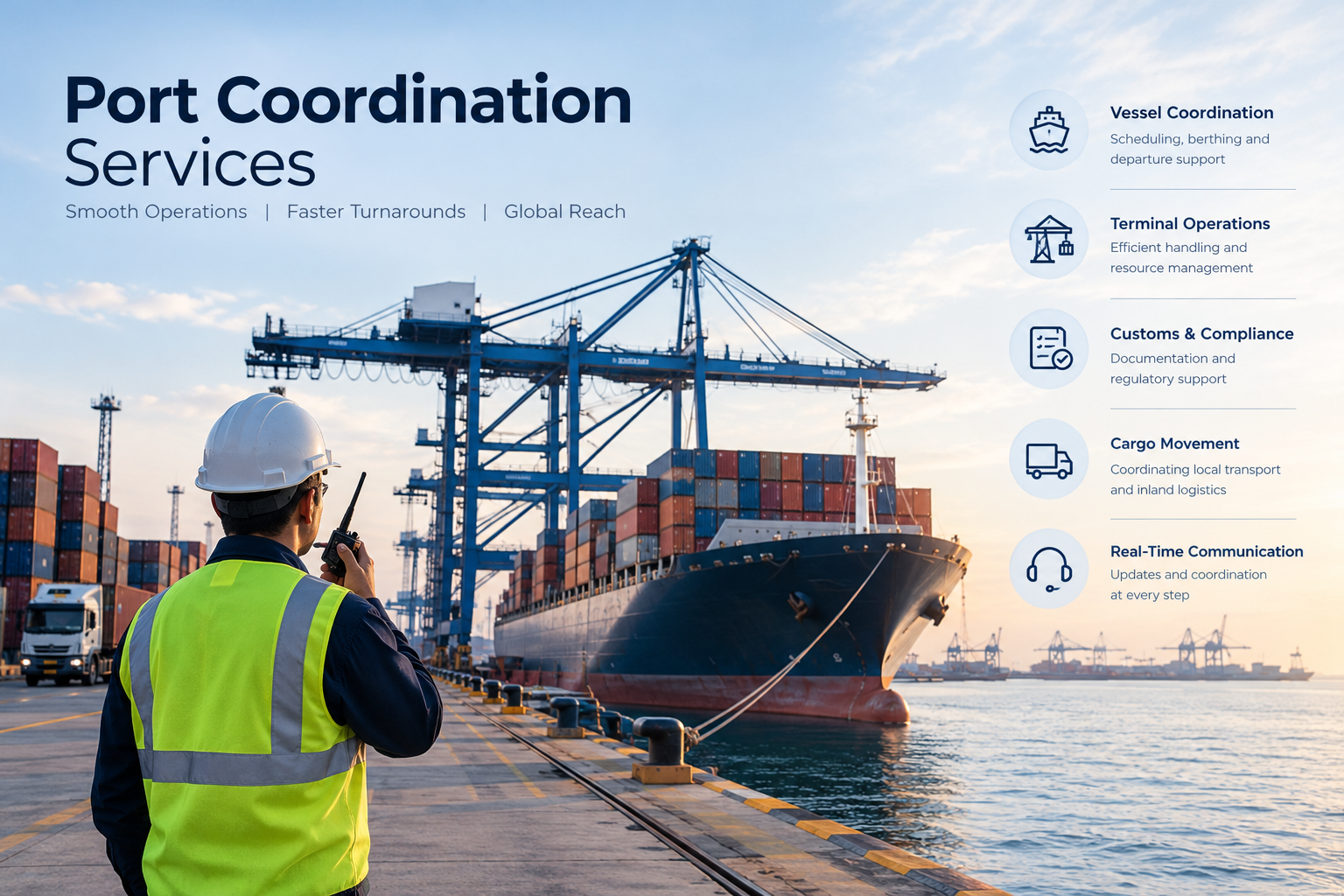
Types of Port Coordination Services
Vessel Operation: It covers all vessel-related responsibilities, including communicating and coordinating with vessel operators, shipping agents, port authorities, and terminal teams at different stages.
Cargo Coordination: It involves managing cargo-related tasks such as loading, unloading, and inspection while providing specialised support as required.
Documents and Customs Operation: It dedicates time to handling cargo, shipment processing documentation, and submitting relevant documents for customs at the port authority.
Crew and Husbandry Facilities: It provides essential services inside the vessel, for example, fresh water supply, medical assistance, etc.
Marine Support Services: It enables additional assistance depending on the shipment type and condition. For example, arrangement of bunkers or assistance with essential repair services.
Inland Freight Forwarding: It connects to associated or external stakeholders for the delivery of goods or cargo to the designated inland locations.
How Do Port Coordination Services Work During a Port Call?
Pre-Arrival Vessel Planning
Post coordination services begin before a vessel arrives at the port. It keeps the port authority updated about arrival timing, vessel information, cargo details, essential documents, and whether any special terminal assistance is required, such as dry docking.
Berth and Bunker Arrangement
The port coordination communicates with port and terminal authorities about berthing arrangements as per vessel sizes and types, and also helps arrange additional requirements, such as bunkers, considering its speciality.
Cargo Handling
It involves meeting responsibilities associated with cargo handling such as loading, unloading, keeping essential documents ready, and the use of special equipment for cargo lift, including heavy machinery.
Fast-Tracking Documentation
At this stage, the service operator submits required documents for the vessel and cargo, such as B/L, shipping manifest, and bill of origin, along with preparing immigration documents for the crew members for faster clearance of both the vessel and crew members.
Vessel Departure Planning
It assists in faster completion of operational formalities and documentation while providing aids for additional departure requirements.
Post-Operation Reporting
It is the last stage of port coordination services. Here, the operator keeps a complete roster of every operational update, cost details, and other information and reports them to the concerned party.
Benefits of Port Coordination Services
The benefits of smoothly operated port coordination services are manifold.
- First of all, it reduces operational delays or any form of misconduct in communication.
- It helps maintain better cost management with transparency while avoiding demurrage, detention, and storage expenses at the best.
- It ensures better cargo and shipment visibility throughout the operation.
- It thoroughly assists with improved customs and compliance.
- Last but not least, proper port coordination also helps ensure well-managed and timely goods circulation at destination locations.
Factorsto Keep in Mind Before Choosing a Port Coordination Operator
Dubai, as a hub of maritime businesses, has a dense network of port coordinators. However, before finalising a port coordinator, the consignor must assess the following criteria.
- The total years of port experience and local experience the coordinator has to understand its core strength.
- The extent and variety of service coverage to support versatility and business adaptability.
- A special assessment of customs and documentation to figure out its compliance support system.
- A critical eye on the end-to-end cost statement to understand the transparency factor.
This is all about port coordination services in a nutshell. Whether a shipping agency or a maritime freight forwarder, a business seeking such services must verify the standard of core service parameters along with the company’s reputation before finalising the contract.


